Critter Corner: Three bears and Georgeson Botanical Garden.

Alaska, Photography, Wildlife

Bears, what needs to be said? Large, viscous, cute, curious, smart, omnivorous, powerful and today, wooden. Bears in Denali National Park got a lot of attention this year, when a hiker photographing a grizzly was mauled to death last August. Remarkably, this was the first fatality in the Park’s 95-year history. Bears are incredibly fast, and the estimated “50 yards” between the bear and his victim leaves little room for evasive measures. Keep your distance.

Keeping distance wasn’t a problem during the Denali Park Lottery last September. This Alaskan lottery allows 400 vehicles a day to drive all the way into the park, a trip usually reserved for tour buses. Park Rangers are fast to converge on eager photographers, keeping them safe distances from wildlife.

Please click images to view full size.
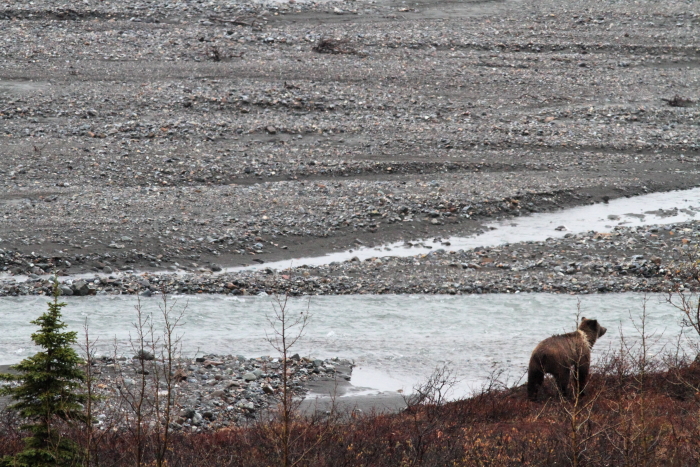
Bear gazing over riverbed.

A bear pauses while climbing a steep, rocky slope.

For some slightly different bear action, check out this statue of a bear at UAF’s Georgeson Botanical Garden, the northern-most botanical garden in North America. I hadn’t walked through in awhile, and found lots of lovely sculptures had been added. What originally caught my attention, though hard to see in the picture, was an ear of corn someone had placed in the bears paws, reminding me of the fall harvest.
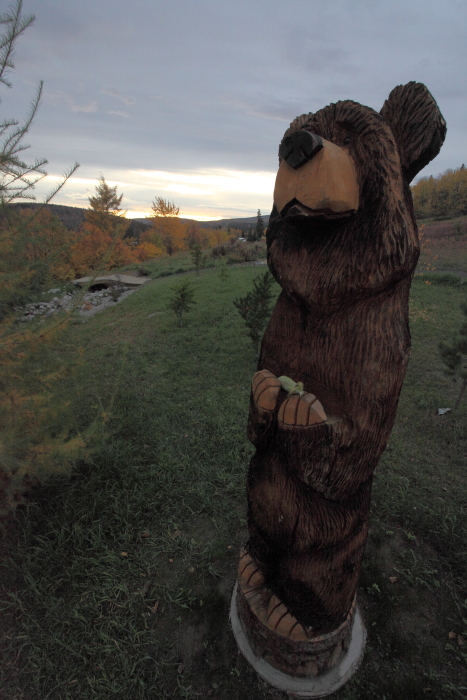
Georgeson Botanical Garden Wooden Bear

Foliage on Mt. Index, Washington State.

Uncategorized

I had been pondering what my next post should cover earlier today, the decision became easy when I read a comment I received from Where’s My Backpack?, a travel-themed blog, inviting me to her weekly travel theme of foliage.

Foliage seems to be one of those unique subjects, truly different everywhere you look. Which is amazing because there is a lot of foliage, but no two ever look exactly the same. Photographs frequently benefit from different perspectives, high or low angles, though I find photographs of foliage do more then normal. My thinking is because of the incredible depth and layers that can be achieved.

Today’s images hail from Mt. Index, in the Cascade Range, Washington State. The first image is a fun silhouette pattern of the curved branch in the foreground.

Curved Branch

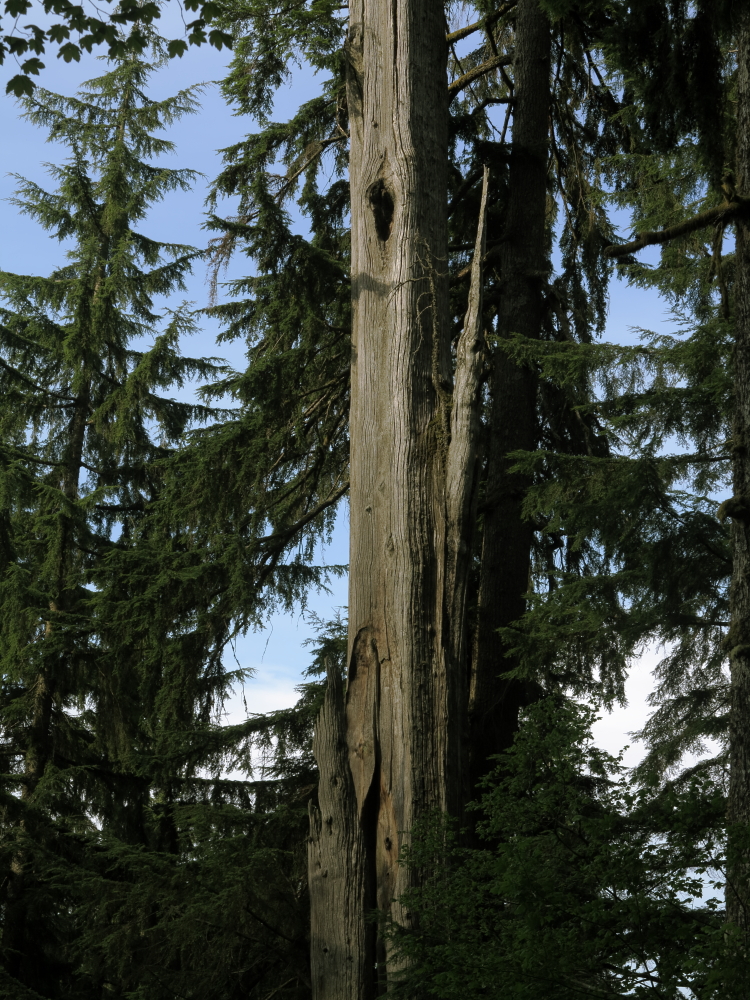
The second image benefits from direct sunlight on the main subject, a dead tree with a hole that looks like a nice home for a lucky bird.

Dead tree

Weekly photo challenge: Solitary

Alaska, Black & White, Film, Landscapes, Photography, Portraits, Travel, Weekly Photo Post

Solitary: being, living or going alone or without companions. The word instantly conjurs images of some distant wayfarer or contemplative individual. For this installment of the Weekly Photo Challenge, I will show you three of my interpretations of solitary, images I believe convey the mood through subject matter and compositional elements.

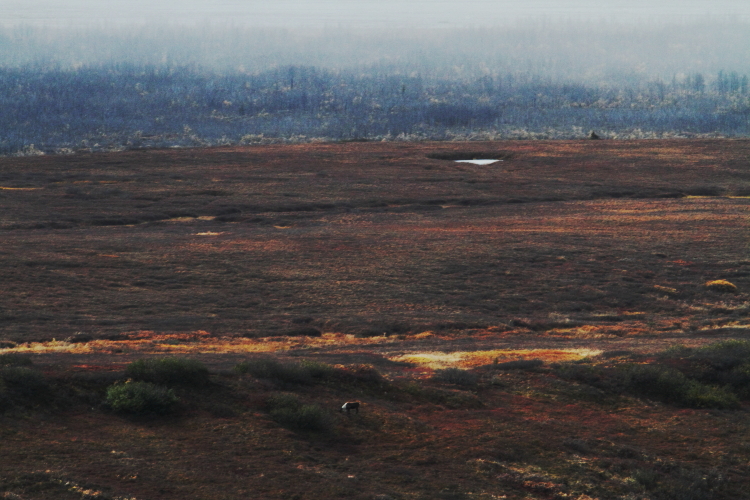
First: a very literal interpretation of solitary. In Denali National Park, a lone-grazing caribou is seen in vast tundra. I wont even begin to speculate on the distances, however it was shot with a 300MM telephoto lens on a Canon 7D. The importance of the 7D is the smaller APS-C sized sensor increases the 300MM lens to an effective focal length of 480MM! As focal length increases, the depth of a picture is flattened, making the relationships of everything seem closer.

In short, this caribou is very alone.

Please click on the images to view full size.

Lone caribou in Denali National Park, Sept. 16, 2012

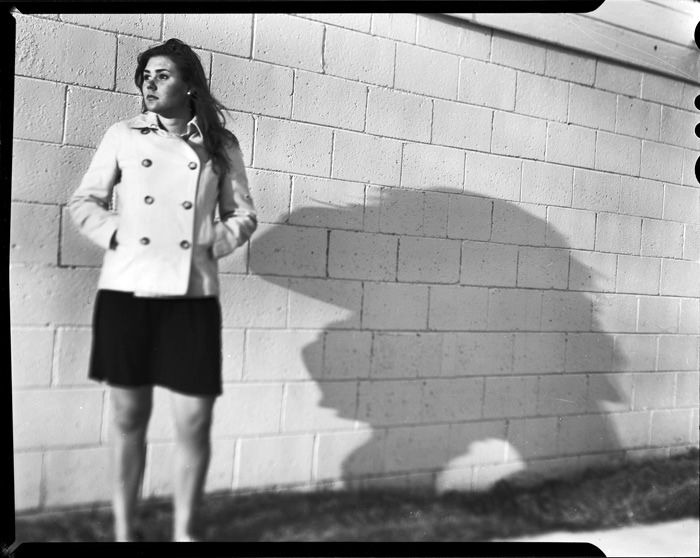
My second image is more metaphorically solitary. The model and her shadow are all the viewer has to dwell on. I think her gaze off the edge of the frame, often deemed poor composition because the viewer wonders what the subject is looking at, gives the feeling that there is nothing besides more wall, adding to the solitary feeling. Also helping is the edge of the 4×5 film, terminating any curiosity about what else there may be.

Crystal at Creamers Field

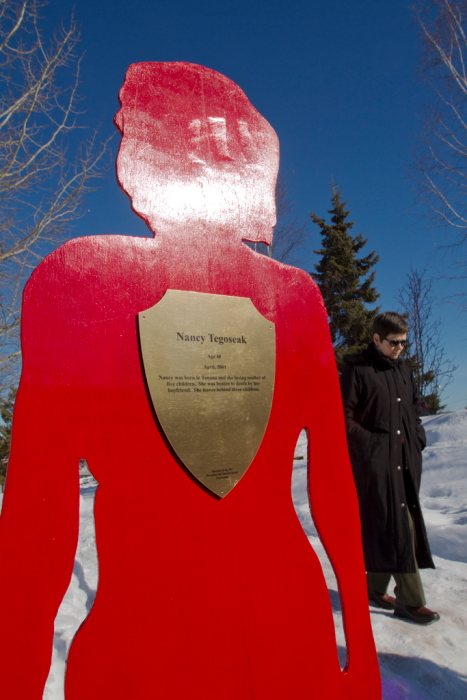
Finally a somber event that would leave anyone feeling solitary. A woman walks past a cutout to honor a victim of domestic violence. The plaque reads,

“Nancy Tegoseak, Age 40, April, 2004. Nancy was born in Tanana and the loving mother of five children. She was beaten to death by her boyfriend. She leaves behind three children.”

Weekly photo challenge: Everyday life.

Alaska, Photography, Portraits, Weekly Photo Post

In Alaska, everyday life is a rather subjective term. Sure there are things done every day: eating, conversing and work. Then there are the things that are everyday life dependent on season. In winter skiing, outerwear, shoveling snow, even cars in the ditch are everyday life. In the summer biking, hiking, gardening and fishing are just a few everyday life sights. Not to say that these events can’t cross seasons, such as ice fishing or roller skiing.

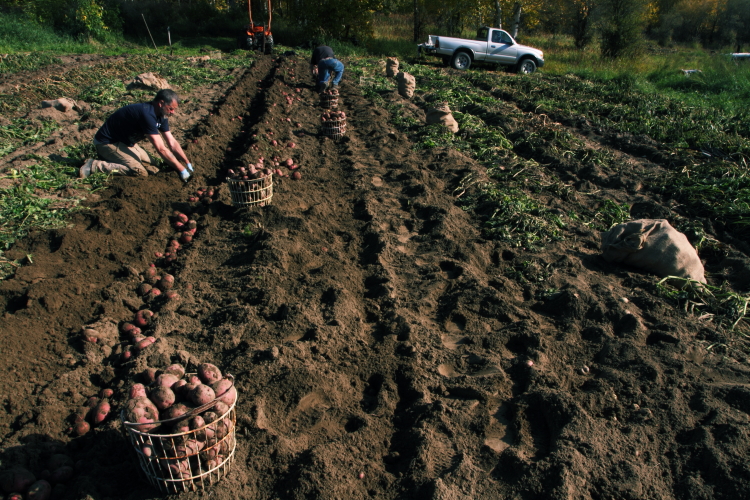
Here are my two photos of everyday life from summer in Alaska. Please click on the images to view full size.

Fishing, farming and gardens are popular with the near 24-hour daylight received during Interior Alaska’s summer.

Digging potatoes in Fairbanks, September 12, 2012.

Fly fishing on the Chena River, downtown Fairbanks, June 16, 2012.

Mt. Rainier: I fell asleep beneath the flowers

Landscapes, Macro, Photography, Travel

Wildflowers are a main attraction to be found on Mt. Rainier. There are obviously many others: great views, unique structures, waterfalls, glaciers and abundant wildlife. I will feature them all in the weeks to come. But it’s Friday, so let us relax, enjoy the beautiful fall and maybe daydream a little. To facilitate those feelings take a look at the pretty purple flowers.

Please click on the image to view full size.

Weekly photo challenge: Near and far

Landscapes, Photography, Travel, Weekly Photo Post

The weekly photo challenge is a different photo assignment from dailypost. This week is near and far, two-dimensional images with a three-dimensional feel. Low point-of-view and converging diagonal lines are two ways to accomplish this, another approach is get some high elevation. To increase the effect foreground objects or size perspective give depth.

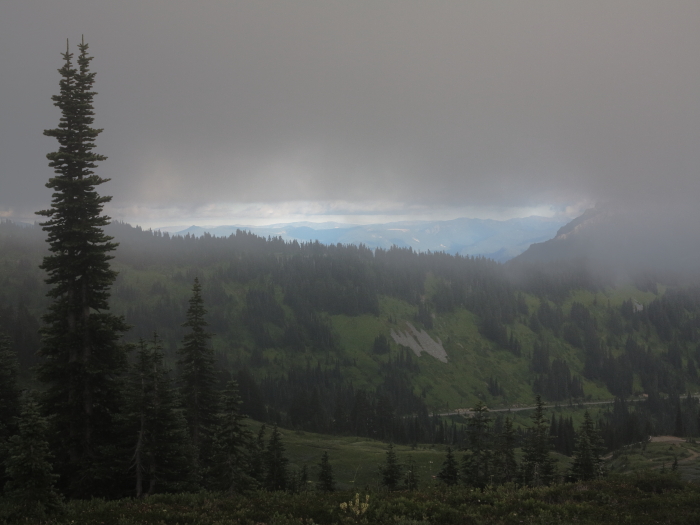
My image comes from a very overcast day on Mt. Rainier in Washington. Not only does the ominous hanging cloud provide more of a foreground it creates an extra horizon line and a tunnel for the eye, directing it towards the hundreds of miles of rolling foothills.

Please click on the image to view full size.

Mountain Stage

Alaska, Arts, Music, Photography, Portraits

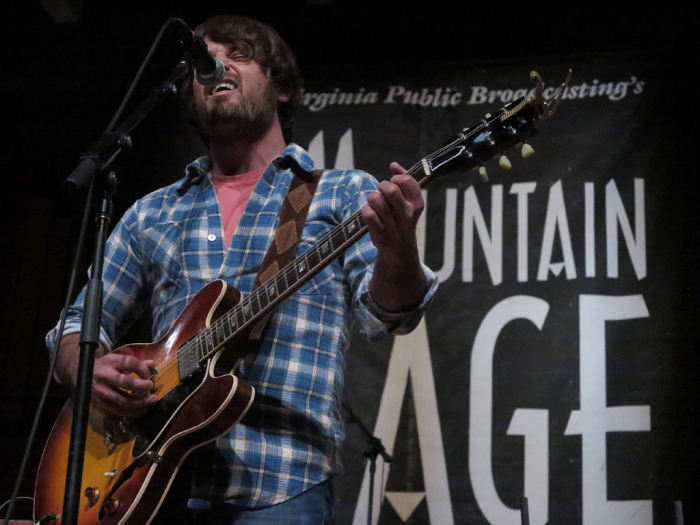
West Virginia Public Broadcasting’s show Mountain Stage recently made a trip to Fairbanks, Alaska. For those unfamiliar with this production, it’s live-concert recording with multiple bands, aired nationally after some post-production work. Here’s a link to an article I wrote which talks more about the event, “Mountain Stage unites Alaska with national music scene,” including pictures of the event, which took place at UAF’s Davis Concert Hall in the Fine Art Complex.

Here are a few teasers from the article I linked to above.

Tim Easton plays in the Davis Concert Hall

Fairbanks band Steve Brown and the Bailers open the second night of Mountain Stage

Shooting concerts can be difficult, when not dealing with lack of light it’s often harsh spotlights, causing highlights to blow out and shadows to be lost. I cranked up the ISO to 3200 or 6400 and just hoped for the best.

Swans and bikers on the Richardson Highway

Alaska, Landscapes, Photography, Travel, Wildlife

The Richardson Highway is 368 miles of pavement connecting Fairbanks, Alaska with Valdez to the south. The highway is typical of those found in Alaska: crossing mountain ranges and a very steep pass, with the occasional view of a glacier. Also common among many Alaskan roads, wildlife viewing. A trip down to Valdez earlier this summer brought multiple sightings and photo opportunities of swans.

Please click on the image to view full size.

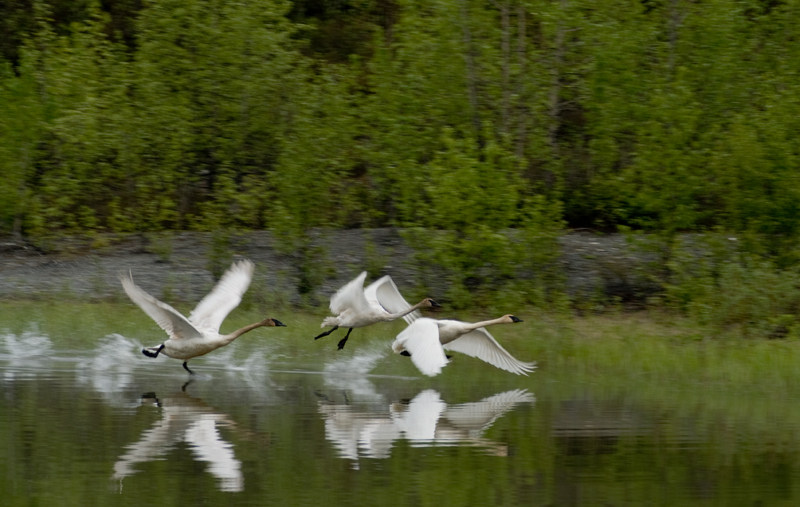
The first group of the birds were farther off the road and didn’t allow me to get very close before taking flight, but offered me a nice action shot in the process.

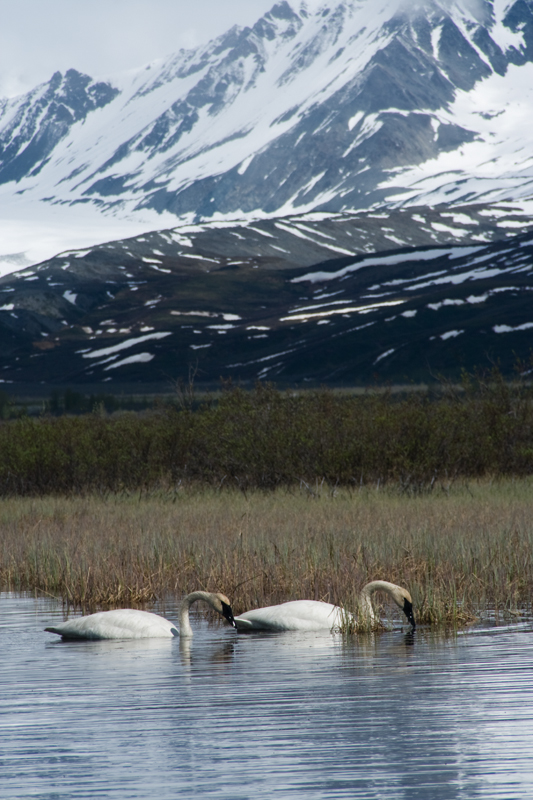
The second group, much closer to the road, was far to concerned with eating to be spooked by my presence.

Then, after a few minutes of photographing, I got that unique shot photographers hope for. There in remote Isbabel Pass, more then 100 miles south of Fairbanks and with Gulkana Glacier in the background, a long-distance biker seemed to come out of nowhere, stopping to take a picture himself. Unfortunately without the preceding picture one easily looses the beauty of these large, graceful and powerful birds.

Kodak Retina double exposure

Abstract, Alaska, Film, Photography

I read an ad for a garage sale that specifically said antique cameras, needless to say I couldn’t resist. To my delight I found a Kodak Retina IIIc. Based off the serial number from this 35MM camera it was made between 1954 and 1957 in Stuttgart, Germany. This awesome camera can be slow to use, but features a qreat 50mm, Schneider 2.0 lens. It is also has a solid feel, and at $25 price tag, with a $50 cleaning at a local shop, I couldn’t be happier with the cost.

It always fun to imagine the pictures an old camera has taken, and equally fun to image the ones it has left.

Please click on the image to view full size.

Dog sign double exposure

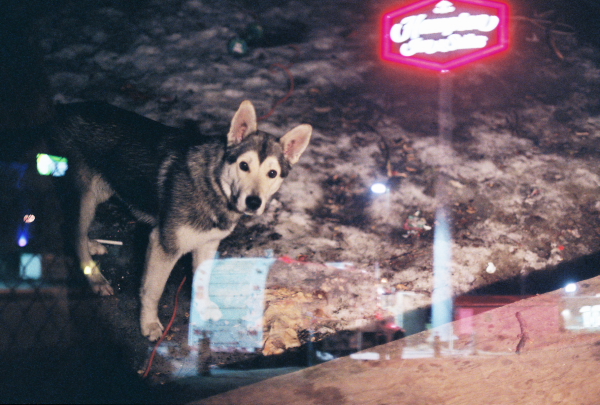
One of the rolls I shot was old 400 ASA film, and somehow got double exposed. No complaints here as the contrast between neon pink hotel sign and the curious gaze of the dog in the woods mimics a feeling I often have when looking at some of todays buildings.

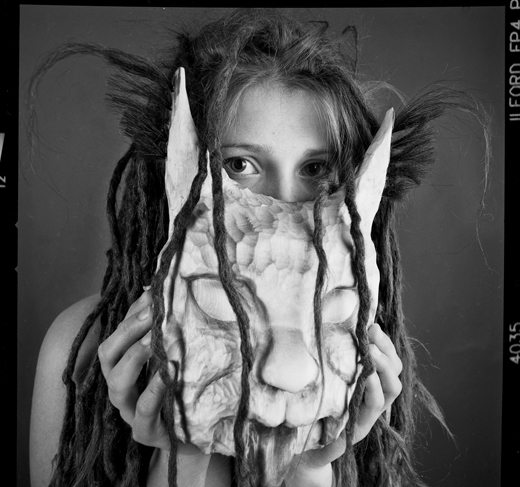
Suvi and her Lynx transformation mask.

Alaska, Arts, Film, Photography, Portraits

As part of my art minor I’m taking a Native Arts of Alaska class. It’s emphasis is in wood carving, and masks are a very popular form of Native art. A friend of mine and Finnish exchange student made a Lynx transformation mask out of Birch. I had to do a shoot, a transformation shoot if you will, with Suvi and her mask. You will likely instantly understand why I wanted to, but her long, red dreads offered the perfect gateway between mask and creator.

Please click on the images to view full size.